
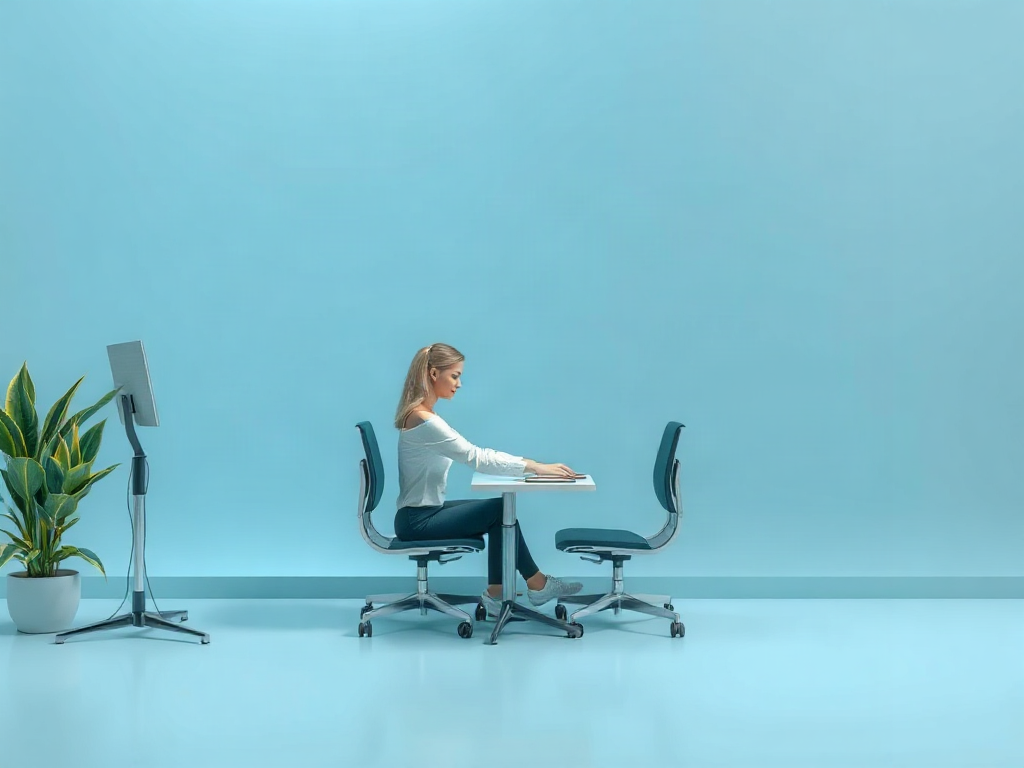
Movement breaks for stiff joints at work are most useful when they interrupt prolonged sitting or standing with brief, comfortable changes in position throughout the day. A practical starting point is to move for one to three minutes about every 30 to 60 minutes, using short walks, chair-assisted leg movements, shoulder rolls, and gentle hand motions. The goal is not a demanding workout but repeated joint motion, muscle activity, and relief from one fixed posture. Movements should stay within a comfortable range and should not cause sharp pain, swelling, dizziness, or worsening symptoms.
Why Do Work Postures Make Joints Feel Stiff?
Work-related stiffness often develops because the body remains in a narrow range of positions for too long. A desk worker may keep the hips and knees bent while the hands hover over a keyboard. Someone at a counter may stand with most of their weight on one leg. Neither posture is automatically harmful, but holding it without variation can leave muscles feeling tight and make the first few movements afterward feel slow or uncomfortable.
Joints are designed to move through changing loads and positions. When movement pauses, nearby muscles contribute less to circulation and stop alternating between contraction and relaxation. The joint itself is not necessarily damaged; the sensation may reflect temporary resistance in muscles and other tissues around it. That distinction matters because a forceful stretch is not always the best response. Small, repeated motions often fit the situation better than trying to push immediately to the end of the available range.
Consider two employees who both notice stiff hips at 3 p.m. One sits through several long video meetings, while the other works at a standing station without changing stance. Buying a standing desk may help the first employee vary posture, but it does not solve the second employee’s problem. The useful variable is position change, not whether sitting or standing is labeled the healthier option. Alternating between a chair, standing, and brief walking usually provides more variety than committing to one supposedly ideal posture.
Workspace setup still affects how easily someone can vary position. A screen placed far to one side may encourage repeated trunk rotation, while a chair that is too high can leave the feet unsupported. Frequently used objects should be reachable without sustained leaning, and the feet should have a stable surface when seated. These adjustments reduce unnecessary strain, but they do not replace movement. Even a well-fitted workstation becomes a fixed posture when used continuously.
A common mistake is waiting until stiffness becomes distracting before moving. At that stage, people may respond with aggressive neck circles, deep squats, or long stretches that are difficult to control in office clothing. Earlier and gentler position changes are easier to repeat. Notice when stiffness appears, which areas are affected, and which work tasks precede it. That pattern provides a better basis for planning breaks than a universal posture rule.
How Often Should You Take a Movement Break?
A workable starting schedule is a brief position change every 30 to 60 minutes, adjusted to symptoms, duties, and mobility. The interval is a practical prompt rather than a medical prescription. Someone who becomes uncomfortable after 25 minutes may need earlier breaks, while a worker who naturally walks between tasks may already be changing position often enough without a formal timer.
Frequency usually matters more than turning one break into a miniature exercise session. A two-minute walk to refill a bottle changes the angles at the ankles, knees, hips, and spine while engaging muscles that were relatively quiet at the desk. By contrast, taking one long walk at lunch does not fully offset an entire morning and afternoon spent in the same position. The lunch walk may still be valuable, but it serves a different purpose from regular interruptions.
| Work Situation | Practical Starting Prompt | Possible Movement |
|---|---|---|
| Continuous computer work | Change position every 30–60 minutes | Stand, walk briefly, or perform seated leg motions |
| Back-to-back meetings | Move during transitions when possible | Walk while listening or stand for part of a call |
| Prolonged standing | Shift the task or stance regularly | Sit briefly, march gently, or alternate foot support |
| Repetitive hand use | Pause at natural task boundaries | Open and close the hands and relax the grip |
Use symptoms and work quality to refine the interval. A useful break should make the next movements feel easier without leaving the joint irritated or the employee breathless. If stiffness returns well before the next planned pause, shorten the interval rather than making each movement more intense. If a timer repeatedly interrupts calls or concentrated work, link breaks to predictable events such as sending a report, finishing a meeting, or completing a group of transactions.
The largest scheduling error is choosing a perfect plan that cannot survive a normal workday. Reminders every 20 minutes may become background noise, while an hourly prompt may fit naturally between tasks. Workers with limited control over breaks may use smaller options: uncrossing the legs, changing foot position, straightening one knee under the desk, or relaxing a tight grip. These do not provide the same whole-body change as walking, but they are more practical than doing nothing until the next formal break.
Track the response for several days rather than judging one attempt. Signs the schedule is working include less hesitation when standing, fewer episodes of end-of-day tightness, and reminders that feel manageable. Increasing soreness, lingering discomfort after each break, or a need to use progressively stronger movements suggests that the routine or the underlying assumption needs reconsideration.
Which Movements Fit a Workday?
The best workplace movements are simple, controlled, and compatible with the space available. They should take the affected areas through a comfortable range without requiring speed, deep positions, floor contact, or special equipment. A useful sequence often moves several regions because stiffness at work rarely respects a single joint: hands operate a mouse, shoulders remain forward, hips stay bent, and ankles move very little.
For a desk-based break, begin by placing both feet on the floor and changing posture before adding motion. Open and close the hands without squeezing hard, then bend and straighten the elbows. Roll the shoulders gently backward or reach the arms forward and return them to the sides. Straighten one knee at a time, keeping the motion smooth, and move each ankle up and down. If standing is comfortable, use the desk or chair for light balance support and walk for a minute or perform a few easy weight shifts.
A compact sequence can follow this order:
- Release the working posture: let go of the mouse, uncross the legs, and bring the head over the shoulders.
- Move smaller joints: relax the fingers, rotate the forearms, and move the ankles within a comfortable range.
- Change the large-joint position: straighten the knees, stand if appropriate, and take several unhurried steps.
- Recheck comfort: return to work only if the movement settles rather than aggravates the area.
The right choice depends on the worker. Someone with balance concerns may be safer using seated movements or holding a stable surface. A person with sensitive knees may prefer a level walk to repeated chair squats. An employee whose hands feel stiff after data entry may benefit more from releasing the grip and changing input tasks than from stretching the legs alone. Movement should match the posture and body area that have remained still.
More range is not automatically better. Forcing the neck into large circles, bouncing into a hamstring stretch, or repeatedly bending a painful joint can turn a restorative pause into an irritant. Mild muscular effort or a gentle stretching sensation may occur, but sharp pain, catching, instability, or symptoms that persist after the break are reasons to stop. Workers with recent injuries, surgery, inflammatory conditions, or clinician-provided restrictions should follow individualized instructions instead of adopting a generic office routine.
The most common misconception is that a movement break must look like exercise to count. Quiet actions performed consistently are often more sustainable in a shared workplace. Walking to speak with a colleague, standing during part of a phone call, or alternating between keyboard and non-keyboard tasks can supply useful variation without attracting attention or requiring extra time.
How to Build Breaks Into Your Workflow
Movement breaks become reliable when they are attached to work events rather than left to memory. Concentration narrows attention, so a person may not notice stiffness until standing becomes uncomfortable. A visible calendar prompt, a watch vibration, or a task-based cue can interrupt that pattern without requiring constant self-monitoring.
Choose one cue that already occurs several times during the day. Finishing a meeting could trigger a walk to the printer or a lap around the room. Sending a batch of emails could prompt standing and moving the ankles. A customer-facing employee might use a quiet period to shift position and open the hands. The cue should fit the job; an alert that routinely sounds during calls will soon be ignored.
Workplace constraints deserve realistic planning. In an open office, large stretches may feel awkward. In a production setting, leaving the station may require coverage or permission. Remote workers may become absorbed in tasks without natural transitions. The solution is to create two levels of breaks: a full position change when circumstances allow and a discreet backup for restricted moments. The backup might include seated knee extensions, heel raises, hand relaxation, or moving the shoulders away from a rounded position.

Use this short implementation checklist:
- Identify the trigger: note when and during which task stiffness appears.
- Select one primary movement: choose a walk, sit-to-stand transition, or gentle joint motion that feels comfortable.
- Create a backup: keep a seated or stationary option for meetings and busy periods.
- Review the response: assess comfort during movement and for the next hour, not only at the instant of the break.
Do not try to overhaul the entire day at once. Beginning with two dependable periods—such as midmorning and midafternoon—can reveal whether the selected motions are suitable. From there, add cues where prolonged stillness remains. This staged approach is less comprehensive initially than an hourly schedule, but it produces better information about what the worker can maintain.
A failed routine usually has one of three features: the prompt is too frequent, the movement is too ambitious, or the break conflicts with essential duties. Adjust the design instead of interpreting inconsistency as a lack of discipline. The strongest sign of a workable plan is not perfect timer compliance; it is that position changes begin to happen naturally around meetings, focused tasks, and transitions.
When Does Stiffness Need More Than a Movement Break?
Movement breaks are a comfort and activity strategy, not a diagnosis or treatment for every cause of stiffness. Temporary tightness associated with a long work posture may ease after gentle motion. Symptoms that are persistent, severe, unexplained, or accompanied by other changes should not be assumed to result from sitting or standing.
Pay attention to the pattern. Stiffness that repeatedly worsens despite reasonable position changes may point to a workstation issue, excessive task repetition, an injury, or a health condition requiring assessment. Visible swelling, warmth, redness, marked weakness, loss of function, numbness, or a joint that locks or gives way are not problems to push through with a more vigorous office routine. Sudden severe symptoms or stiffness following a significant injury may require prompt medical attention.
The timing also provides useful context. Symptoms limited to the end of a long typing session suggest a different work trigger from stiffness that is prominent on waking, occurs across several unrelated joints, or continues during days away from work. Keeping a brief record of the affected area, task, duration, associated symptoms, and response to movement can make a discussion with a healthcare professional more specific. The record should describe what happened rather than attempt to assign a diagnosis.
Ergonomic changes may be appropriate when one task reliably triggers discomfort. An occupational health contact, physical therapist, occupational therapist, or other qualified professional may help evaluate work demands and individual limitations. Equipment alone should not be treated as a cure: a new chair cannot correct every source of stiffness, and a standing desk can simply exchange prolonged sitting for prolonged standing.
A common failure mode is using temporary relief as proof that nothing else is wrong. Gentle movement can reduce the sensation of stiffness in some situations without resolving its cause. If symptoms progressively intensify, interfere with ordinary duties, disturb sleep, or require repeated avoidance of normal movements, seek professional guidance. Movement breaks can remain part of the workday if they are comfortable and appropriate, but they should not delay evaluation of concerning changes.
Conclusion
A sustainable workday routine favors frequent position changes over occasional, strenuous stretching. Identify the tasks that keep the same joints still, choose a comfortable motion that fits the workspace, and connect it to a dependable cue such as the end of a meeting. Keep a discreet seated option for times when walking is not possible, and adjust the interval if stiffness returns before the next planned pause.
Judge the routine by how the joints respond during the break and afterward. Easier transitions and less accumulated tightness suggest the plan is useful; increasing pain or lingering irritation indicates that the movement, timing, or underlying assumption needs review. Workspace adjustments can reduce awkward positions, but no chair or standing desk replaces regular variation. Persistent stiffness or concerning symptoms deserve assessment rather than increasingly forceful self-directed exercises.
Frequently Asked Questions
How long should a movement break last?
One to three minutes can be enough to change position and move several joints. Longer breaks are optional; consistency and comfort usually matter more than turning each pause into a workout.
Can I take useful movement breaks without leaving my desk?
Yes. You can open and close the hands, move the ankles, straighten one knee at a time, relax the shoulders, and change seated position. Walking adds whole-body movement when space and duties allow.
Is standing all day better for stiff joints than sitting?
Not necessarily. Prolonged standing can also become uncomfortable. Alternating among sitting, standing, and walking generally provides more position variety than replacing one fixed posture with another.
Should movement breaks hurt slightly to be effective?
No. Use a comfortable, controlled range. Stop if a movement causes sharp pain, catching, instability, dizziness, or symptoms that continue to worsen after the break.
When should I ask a healthcare professional about joint stiffness?
Seek guidance for persistent or worsening stiffness, significant loss of function, or symptoms accompanied by swelling, redness, warmth, weakness, numbness, locking, or instability. Sudden severe symptoms may require prompt attention.