
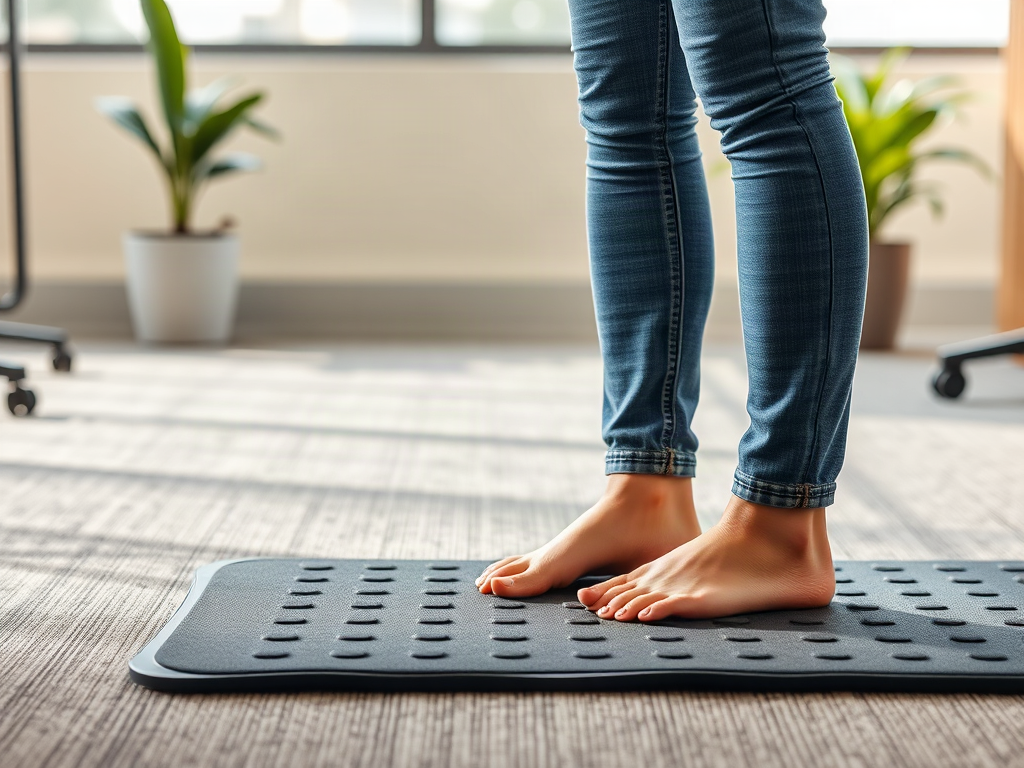
Anti-fatigue mats may improve lower-limb joint comfort during prolonged standing by slightly cushioning foot impact, encouraging small postural adjustments, and reducing the need to brace against a hard floor. Their value depends on resilient but stable material, adequate size, a flat edge, supportive footwear, and a work surface that does not force awkward reaching. A mat that is too soft, thin, narrow, curled, or slippery can increase ankle effort and create a trip hazard rather than easing discomfort. Use one where standing is unavoidable, test it during shorter work periods first, and stop relying on it as the sole response if swelling, numbness, weakness, or persistent pain develops.
How Standing Surfaces Influence Lower-Limb Comfort
Lower-limb comfort during standing is affected by more than the condition of the knees or hips. A rigid floor gives little under the feet, so the body continually manages pressure through the soles, ankles, calves, knees, and hips. Holding one position also limits the small weight shifts that normally distribute load. By the end of a long work period, the result may be aching feet, tight calves, sore knees, or a heavy sensation in the legs.
An anti-fatigue mat changes the contact surface beneath the feet. Its resilient layer compresses slightly under body weight, which may reduce the harshness of contact with concrete, tile, or other hard flooring. The surface can also make subtle movement more comfortable, allowing a person to alternate pressure between the left and right leg instead of locking both knees and bracing through the lower body.
That effect should not be mistaken for a treatment for arthritis, tendon problems, or an injury. A mat addresses one environmental load: prolonged standing on a hard or unforgiving surface. It does not correct poor workstation height, unsuitable shoes, limited ankle motion, excess reaching, or a schedule that provides no opportunity to sit or walk.
Consider a cashier who stands on concrete for several hours. A suitable mat may make foot pressure less intrusive and encourage occasional repositioning. A kitchen worker, by contrast, may need a surface that tolerates spills and frequent pivoting. Someone who stands at a desk may benefit more from alternating sitting and standing than from adding thicker cushioning alone. The useful question is not whether a mat is soft, but whether it improves the entire standing setup without adding instability.
Readers researching how anti-fatigue mats affect lower-limb joint comfort should therefore evaluate the floor, task, footwear, and movement pattern together. Comfort that improves during standing but worsens after stepping off the mat may signal a poor transition, an overly yielding surface, or a different underlying problem.
What Cushioning Changes—and What It Cannot Fix
Cushioning can soften the mechanical experience of standing, but more cushioning is not automatically better. A moderately resilient mat gives under the foot and then returns enough support for the person to push off and reposition. That balance may reduce the sensation of impact and pressure without requiring the ankle muscles to stabilize every step.
A very soft surface creates a different demand. The foot may sink unevenly, especially when weight shifts from the heel to the forefoot or when the worker turns. The ankle and calf then make repeated corrections to maintain balance. For a person with sensitive feet or tired legs, that extra effort can outweigh the comfort gained from softness. A foam mat that feels pleasant for ten minutes may be tiring after several hours.
The mat also cannot remove the load created by static posture. If a worker keeps the knees locked, leans into a counter, or repeatedly reaches beyond a comfortable distance, the mat only changes the floor beneath the body. Adjusting the work height and keeping frequently used items within easy reach may have a greater effect than replacing one mat with a thicker model.
Pressure distribution is another reason results vary. A person with supportive footwear may notice a modest improvement because the shoe and mat share the cushioning role. Someone standing barefoot on a hard surface may notice a larger difference, but may still need footwear for arch support, traction, hygiene, or task safety. The mat should complement footwear rather than compensate for shoes that are worn out or unstable.
A practical test is to compare two similar work periods rather than judging the product immediately. Notice foot soreness, calf tightness, knee aching, balance, and comfort when stepping on and off the mat. If the legs feel more tired despite reduced foot pressure, the material may be too soft. If comfort is unchanged, the main issue may be static posture, footwear, task design, or a medical concern rather than flooring.
Choosing A Mat For Stability, Fit, And Safety
The best anti-fatigue mat for lower-limb comfort is one that stays flat, provides controlled resilience, and covers the area where standing actually occurs. Thickness alone is a weak selection rule. A stable, moderately cushioned mat is generally more useful than a deep surface that shifts underfoot or catches the toe.
Fit matters because workers rarely stand in one exact spot. The mat should accommodate ordinary side-to-side movement and allow the user to turn without stepping onto an exposed hard edge. At the same time, a mat that extends into a walking route can create a trip risk. Edges should lie flat, and the transition between floor and mat should be easy to see and cross.
Surface texture and backing deserve equal attention. A smooth upper surface may become hazardous around water, grease, or fine debris, while an aggressively textured surface may interfere with pivoting or be difficult to clean. The backing should resist sliding on the particular floor, not merely claim general non-slip performance. A mat that creeps several inches during a shift can place the feet outside the intended cushioning zone and produce an awkward step.
Use the work environment to narrow the choice:
- Dry desk or counter area: prioritize a flat profile, stable backing, and enough coverage for normal stance changes.
- Food, laboratory, or service area: prioritize cleanability, drainage where relevant, and resistance to the substances used in that space.
- Workstation with frequent movement: choose a surface that supports turning and does not create a raised obstacle between adjacent stations.
- Shared workplace: inspect edges and surface condition regularly because different users may wear footwear with different traction and support.
A common mistake is placing a small mat directly in front of a counter and then repeatedly stepping over its edge. Another is using a household rug as a substitute; rugs may bunch, slide, or lack the resilience expected from an anti-fatigue design. Inspect the mat after cleaning and relocation, and replace it if curling, cracking, compression, or backing failure changes how it contacts the floor.
Using An Anti-Fatigue Mat In A Real Work Area
Installation and behavior determine whether a mat produces useful comfort. Place it on a clean, dry floor with the longer dimension aligned to the area where the person stands. Remove packaging folds and allow the mat to lie fully flat before regular use. Keep cords, boxes, stools, and wastebaskets from creating a second obstacle around its perimeter.
Pair the mat with movement rather than standing rigidly on it. Alternating weight between the legs, taking brief walking breaks, changing foot position, and using a footrest when appropriate can distribute effort across different tissues. A sit-stand workstation should be adjusted so the elbows, screen, and work surface remain usable in both positions; otherwise, the user may lean forward or elevate the shoulders while trying to stand comfortably.
For a new user, a staged trial is more informative than an all-day test. Use the mat during a shorter standing block, then assess comfort later that day and the next morning. Increase use only if balance remains easy and there is no new ankle, calf, knee, or hip fatigue. This approach helps distinguish initial unfamiliarity from a surface that is genuinely too unstable.

Signs that the setup is working include less end-of-shift foot pressure, easier weight shifting, and no increase in wobbling or effort while turning. Signs of failure include sliding, curled edges, persistent sinking, new calf fatigue, or a tendency to step off the mat to feel stable. If those problems appear, first check the floor, backing, mat placement, and footwear before assuming that more cushioning is needed.
The strongest setup may combine several modest changes: a properly sized mat, shoes with secure fastening and appropriate support, a counter at a workable height, and scheduled opportunities to sit or walk. Adding a mat while leaving a poorly positioned screen or repeatedly reaching across a deep counter may offer only limited relief. The mat is a workplace modification, not a replacement for task redesign.
When A Mat Is Not The Right Solution
A change in standing comfort should be interpreted alongside symptoms. General tiredness after a long shift may respond to surface and posture changes, but persistent one-sided swelling, numbness, weakness, marked redness, or pain that continues away from work deserves attention beyond equipment selection. A mat should not be used to delay assessment of symptoms that are worsening or interfering with ordinary walking.
People with balance limitations may need a firmer, lower-profile surface rather than a plush mat. Anyone who uses a cane, walker, braces, or other mobility equipment should consider how the mat affects rolling, turning, and edge clearance. A surface that is comfortable for a stationary worker may be unsuitable for someone who must pivot quickly or move between several stations.
Standing may also be the wrong exposure to optimize. If the task can be reorganized to alternate sitting, walking, and standing, reducing uninterrupted standing often has more value than improving the standing surface. A mat cannot offset long periods of immobility, insufficient recovery time, or repeated lifting from an awkward position.
Use this compact decision check before buying or retaining one:
- Identify whether discomfort is mainly linked to a hard floor, prolonged stillness, footwear, task height, or a symptom present in other settings.
- Measure the standing zone and the nearby walking path so the mat can cover useful movement without obstructing traffic.
- Choose stable resilience, a flat edge, suitable traction, and cleaning compatibility before choosing extra thickness.
- Trial the mat during a shorter work period and record comfort, balance, calf effort, and transition safety.
- Remove or replace it if it slides, curls, sinks excessively, or produces new symptoms.
That process prevents a common weak assumption: that any soft surface must reduce lower-limb strain. Comfort is a functional outcome, not simply a feeling of softness under the feet. The right surface should make ordinary movement easier while preserving secure contact with the floor.
For additional guidance, consult workplace ergonomics materials from government occupational-safety agencies, manufacturer documentation for cleaning and slip resistance, and a qualified healthcare professional when lower-limb symptoms persist or include swelling, numbness, weakness, or significant gait changes.
Frequently Asked Questions
Can an anti-fatigue mat reduce knee discomfort?
It may reduce discomfort linked to prolonged standing on a hard floor, but it does not treat arthritis, injury, or other causes of knee symptoms. Stability, footwear, posture, and movement breaks also matter.
Is a thicker mat better for lower-limb comfort?
Not necessarily. Excessively soft or thick material can increase ankle stabilization demands and make turning less secure. Controlled resilience and a flat, stable surface are usually more useful selection priorities.
How long should someone test a new mat?
Begin with a shorter standing period and assess comfort during the shift and afterward. Extend use only if balance remains secure and there is no new calf, ankle, knee, or hip fatigue.
Can a mat replace supportive work shoes?
No. A mat and footwear affect the feet in different ways. Shoes still need appropriate fit, traction, and support for the task and the individual.
When should standing discomfort be medically evaluated?
Seek professional advice for persistent or worsening symptoms, especially one-sided swelling, numbness, weakness, marked redness, or pain that affects walking or occurs away from the workplace.
Conclusion
An anti-fatigue mat can make prolonged standing more tolerable when hard flooring is a major contributor to foot and lower-limb discomfort. Its usefulness comes from controlled cushioning and easier weight shifting, not from maximum softness. Choose a stable, correctly sized mat with flat edges and suitable traction, then evaluate it alongside footwear, work-surface height, and opportunities to move or sit. Pay attention to delayed effects: reduced foot pressure is encouraging, but new calf fatigue, wobbling, slipping, or persistent symptoms indicate that the setup needs to change. Treat the mat as one part of a safer standing arrangement, and seek clinical guidance when symptoms extend beyond ordinary end-of-shift tiredness.