
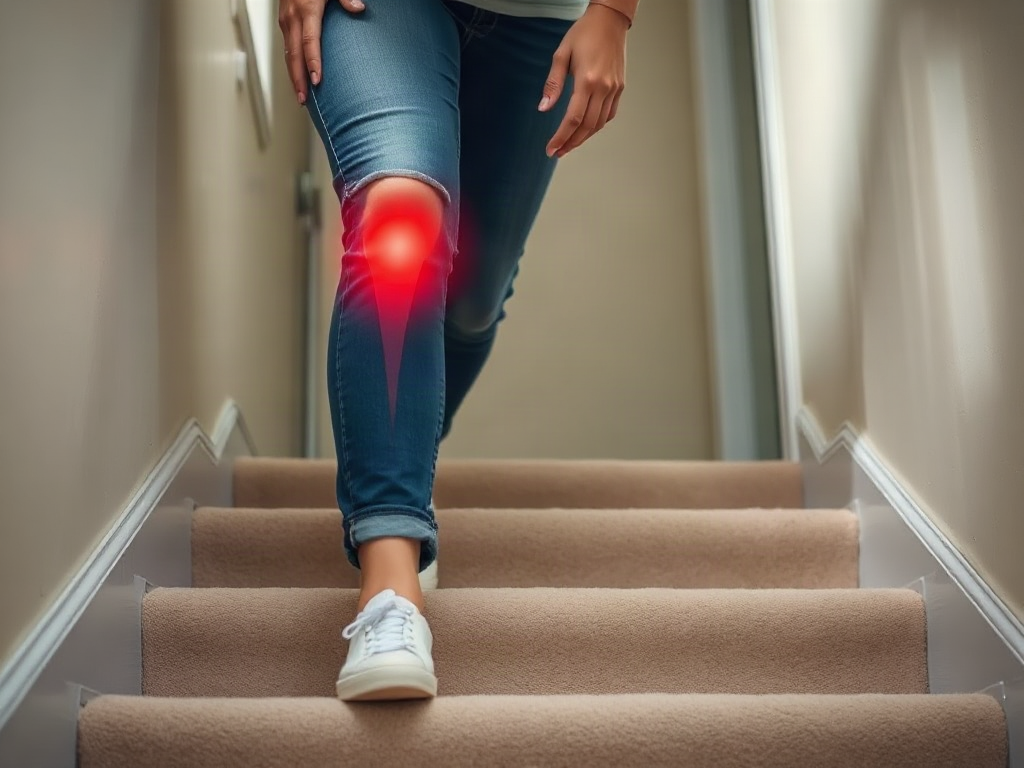
Kneecap pain when going downstairs: causes and relief usually involve reducing stress on the patellofemoral joint while addressing irritation, weakness, or movement-control problems. Descending increases knee-bending forces, so pain may arise from patellofemoral pain, a tendon problem, arthritis, cartilage irritation, or an injury rather than from the kneecap alone. Use a handrail, shorten your step, keep the knee tracking toward the second toe, and temporarily reduce painful squats or repeated stairs. Gentle strengthening of the quadriceps, hips, and trunk often supports recovery, but swelling, locking, giving way, trauma, or persistent symptoms warrant medical assessment.
Why Descending Stairs Loads the Kneecap
Going downstairs is often more provocative than climbing because the front thigh muscles must control the body as the knee bends. The quadriceps work eccentrically, meaning they lengthen while resisting gravity. That control demand presses the patella against the groove at the end of the thighbone. A sensitive joint surface, irritated surrounding tissue, or poor control of the hip and foot can therefore become noticeable on each step.
The symptom pattern matters. Pain directly behind or around the kneecap that worsens with stairs, squatting, kneeling, or sitting with the knee bent is commonly associated with patellofemoral irritation. A sharp spot below the kneecap may point more toward the patellar tendon, while pain along the joint line, swelling, catching, or a history of twisting raises different questions. Location alone cannot establish a diagnosis, but it helps determine whether self-care is reasonable.
Stair angle and technique also change the load. Taking large steps, rushing, or allowing the knee to collapse inward can make the thigh and hip work harder. A person who recently increased walking, started hill training, or returned to exercise after a break may develop symptoms without a single damaging event. That does not mean the knee is being permanently harmed; it means the current demand may exceed its short-term tolerance.
Practical interpretation: pain that is mild, predictable, and absent at rest may respond to load adjustment and progressive exercise. Pain that escalates during ordinary walking, produces substantial swelling, or changes the way the leg functions deserves a more cautious approach. More detail on recognizing patterns appears in kneecap pain when going downstairs resources.
Common Causes And Clues To Notice
Patellofemoral pain is a frequent explanation for discomfort around the kneecap during stair descent. It can reflect several interacting factors, including a sudden activity increase, reduced quadriceps capacity, hip weakness, altered running or walking mechanics, or irritation after prolonged kneeling. The label describes the region and pattern; it does not identify one universal structural defect. Treatment is usually guided by symptoms and function rather than by assuming that the kneecap is “out of place.”
Osteoarthritis may cause front-of-knee pain, stiffness after sitting, creaking, and reduced tolerance for stairs, particularly in older adults or after previous injury. Tendon irritation tends to produce more localized pain at the lower edge of the patella and may be aggravated by jumping, running, or repeated forceful extension. A blow, fall, or twisting incident can involve the meniscus, ligament, bone, or cartilage. New swelling after such an event should not be dismissed as ordinary overuse.
Several clues can help organize the next decision:
- Around the kneecap: often aggravated by stairs, squats, or prolonged sitting.
- Below the kneecap: more consistent with a tendon-related pattern, especially after jumping or sprinting.
- Joint-line tenderness or catching: may require assessment for internal joint involvement.
- Warmth, marked swelling, or systemic illness: needs prompt medical attention rather than exercise testing.
Weak assumptions can delay useful care. A visible grinding sound does not automatically mean severe damage, and normal-looking alignment does not rule out a movement or capacity problem. Conversely, calling every front-knee symptom “runner’s knee” can overlook arthritis or an injury. Keep a short record of when symptoms appear, whether swelling follows, and which activities increase or reduce them. That information is more useful than trying to diagnose the tissue from a symptom search.
Immediate Relief And Safer Stair Technique
The first relief measure is to reduce the most provocative load without stopping all movement. If possible, use a handrail and descend one step at a time for a few days. Place the whole foot securely, slow the lowering phase, and keep the knee aligned roughly over the middle of the foot rather than letting it drift sharply inward. A shorter step reduces the depth of knee bending and may be more comfortable than forcing a normal stride.
When one knee is clearly more painful, a temporary strategy is to lead with the more painful leg while going down, bringing the other foot to meet it. This is not a permanent movement goal, but it can reduce the demand while symptoms settle. Avoid carrying heavy loads on stairs, rushing to “get it over with,” or repeatedly testing the pain. Ice may briefly reduce soreness for some people; a wrapped cold pack should be used for a limited period, never directly on the skin. Heat may feel better for stiffness but is not a substitute for load management.
Modify nearby activities as well. Deep squats, kneeling, downhill walking, and repeated lunges may reproduce the same compressive demand. Replace them temporarily with flatter walking, a higher chair, or shallow range-of-motion work. Complete rest can make the thigh less capable, while pushing through sharp or progressively worsening pain can prolong irritation. A useful boundary is mild discomfort that settles soon after activity and is not worse the next morning; symptoms that linger or accumulate suggest that the dose is too high.
Medication decisions deserve individual caution. Nonprescription anti-inflammatory or pain medicines may be unsuitable with certain stomach, kidney, heart, blood-thinning, pregnancy, or allergy considerations. A pharmacist or clinician can review the safest option. Braces, sleeves, and taping may improve confidence or short-term comfort for some people, but they should complement—not replace—an examination and rehabilitation plan when symptoms persist.
Strengthening And Returning To Normal Activity
Progressive strengthening is often more durable than relying on a brace or avoiding stairs indefinitely. The quadriceps help control descent, while the hip muscles help manage the thigh position. Begin with a level that does not create a clear flare later that day or the next morning. Options may include seated knee extensions through a comfortable range, straight-leg raises, bridges, side-lying hip work, and shallow sit-to-stands. The specific exercise matters less than controlled technique and gradual progression.
For example, someone who hurts on the third stair but walks comfortably on level ground might start with five slow sit-to-stands from a relatively high chair. If that remains settled for 24 hours, the person could add repetitions before lowering the chair or introducing a small step-down. An advanced athlete may need eventual single-leg squats or step-downs, but beginning there can reproduce the very load that caused the flare. Beginners should prioritize control; stronger individuals may need to manage volume, speed, footwear, or training frequency.

Use symptoms as feedback rather than as a pass-or-fail test. Improving tolerance usually appears as less pain during the same stair section, fewer symptoms after sitting, smoother knee control, or the ability to add a small amount of work without next-day aggravation. Failure looks like increasing swelling, limping, night pain, or progressively lower activity tolerance. Those signs call for reducing the dose and reconsidering the diagnosis, not simply adding more repetitions.
Return to stairs in stages: comfortable flat walking, controlled low step-ups, controlled step-downs, and then ordinary stair speed or longer flights. Keep one variable changing at a time. A common mistake is to feel better after several quiet days and immediately resume hills, leg training, and long stair sessions together. The knee may tolerate each separately but not the combined spike. A personalized plan from a physical therapist is particularly useful when weakness, recurrent symptoms, or movement fear limits progress.
When Assessment Is Needed
Arrange a clinical evaluation if kneecap symptoms do not clearly improve after a reasonable period of modified activity and gradual exercise, or if they repeatedly return whenever normal stairs resume. Assessment is also appropriate when pain follows a fall or twist, when the knee locks or gives way, or when swelling is recurrent. A clinician can compare strength, range of motion, hip and foot control, tenderness, and walking mechanics before deciding whether imaging or other testing is useful.
Seek prompt care for inability to bear weight, a visibly deformed knee, rapid major swelling after injury, a hot red joint with fever, severe calf swelling, or new numbness or weakness. These features do not fit a routine mild overuse pattern. A painful click by itself is less concerning than a click accompanied by locking, instability, or loss of motion.
Before an appointment, note the exact pain location, the number of stairs that trigger it, recent changes in exercise or footwear, prior knee injuries, and whether symptoms occur at rest. Bring a list of medicines and relevant health conditions. Avoid trying to prove the problem by repeatedly provoking it in the office or at home. The goal is to provide useful information while protecting irritated tissue.
Readers comparing front-of-knee symptoms with other patterns may also find related kneecap relief guidance useful. The priority is not to identify a named condition from a single symptom; it is to match the level of self-care to the severity, trajectory, and functional impact.
For reliable background, consult patient information from recognized orthopedic, medical, or physical-therapy organizations, and discuss persistent or worsening symptoms with a licensed clinician. Official health-system material can explain examination and rehabilitation options, but online information cannot confirm the cause of an individual’s knee symptoms.
Frequently Asked Questions
Why does going downstairs hurt more than going upstairs?
Descending requires the quadriceps to brake the body while the knee is bent, increasing pressure around the patella. Step height, speed, and inward knee movement can raise that demand.
Should I stop using stairs completely?
Usually, brief modification is preferable to total inactivity when symptoms are mild. Use a rail, shorten the step, descend slowly, and reduce flights if pain worsens during or after the activity.
Can strengthening relieve kneecap discomfort?
Gradual quadriceps and hip strengthening may improve load tolerance and control for some people. Exercises should be progressed only when symptoms remain stable afterward.
Does knee cracking mean the kneecap is damaged?
Noise without swelling, locking, or functional decline is not enough to identify damage. Pain, swelling, instability, or restricted movement carries more clinical significance.
When should I see a doctor or physical therapist?
Seek assessment after significant injury, with major swelling, locking, giving way, fever, inability to bear weight, or symptoms that persist or recur despite sensible activity changes.
Conclusion
Stair descent exposes whether the knee can control a bent-leg load, so kneecap discomfort often reflects a mismatch between current capacity and demand. Begin with safer mechanics, temporary reduction of deep bending and repeated flights, and a gradual strengthening routine rather than complete immobilization or repeated pain testing. Track next-day response: stable or improving symptoms support cautious progression, while swelling, limping, locking, or declining tolerance calls for evaluation. A brace, ice, or medicine may offer short-term comfort, but none explains the cause or builds capacity on its own. Persistent symptoms, injury-related pain, or mechanical problems deserve a clinician’s assessment so treatment can be matched to the actual knee findings.