
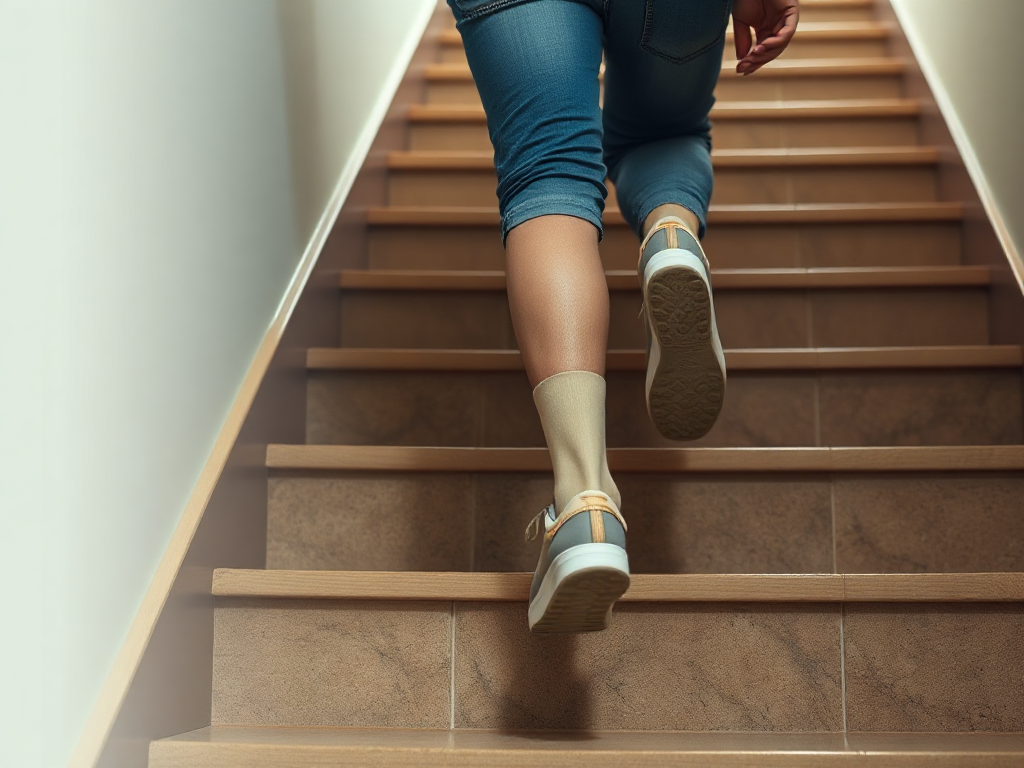
Stairs expose knee arthritis before flat walking because climbing and descending demand more knee bending, muscle control, and force through the joint than level steps. A worn or irritated knee may tolerate ordinary walking but struggle when the kneecap is compressed during deep flexion, the quadriceps control the body downhill, or balance shifts onto one leg. Descending often feels worse because the thigh muscles must brake the body with each step. Use a handrail, shorten your stride, place the whole foot on each step, and track whether symptoms settle after activity. Persistent swelling, locking, instability, or pain that limits daily movement warrants a clinical assessment rather than assuming it is ordinary arthritis.
Why Stairs Place More Demand on an Arthritic Knee
Stair climbing changes the knee’s workload in ways that flat walking does not. On level ground, the leg moves through a relatively modest range of motion and the body’s weight can be shared between both legs during a smooth stride. A stair requires the knee to bend farther, lift the body upward, and coordinate force from the quadriceps, hips, ankles, and foot. That combination can reveal symptoms before ordinary walking becomes uncomfortable.
Arthritis does not affect every knee structure in the same way. Cartilage wear, inflammation of the joint lining, reduced flexibility, muscle weakness, and changes in the kneecap’s tracking may all contribute to stair difficulty. Deep bending can increase pressure between the kneecap and thighbone, while the supporting muscles must produce enough force to keep the knee aligned. A person may therefore walk across a grocery store without much trouble yet feel discomfort when stepping onto a tall stair.
The height and design of the staircase matter. A tall step demands more knee and hip flexion than a shallow step. A narrow or slippery tread can make someone pull harder on the railing or twist the knee to feel secure. Carrying laundry, rushing, or climbing while fatigued adds another layer of demand. These details explain why symptoms may vary from one staircase to another rather than appearing as a simple measure of how far someone can walk.
A common mistake is treating level walking tolerance as proof that the knee is ready for all activities. Flat walking is useful information, but it does not test the same movement pattern. Pay attention to the specific trigger: pain during the push upward, discomfort at the front of the knee, stiffness after several flights, or soreness that appears later. Those distinctions are more useful than simply counting the number of steps.
Readers comparing stair difficulty with their walking routine may also find the broader discussion of why stairs expose knee arthritis before flat walking useful when identifying patterns rather than relying on a single painful episode.
Why Going Down Often Feels Worse Than Going Up
Descending stairs often exposes knee arthritis more sharply because the muscles must control lowering rather than simply producing upward movement. The quadriceps work while lengthening to slow the body’s drop toward the next tread. This braking action, called eccentric muscle control, places a demanding load on the front of the knee. The person may feel pain as the knee bends under body weight, especially around the kneecap.
Going up can still hurt, particularly when the knee lacks strength or when a person pushes forcefully from a deeply bent position. The difference is that climbing allows the hip and ankle to contribute strongly to lifting the body. During descent, the knee may absorb more of the control demand, and hesitation can increase the time spent in a loaded bent position. That is why someone may report that stairs are manageable on the way up but distinctly painful on the way down.
Consider a person leaving a subway station. The ascent may feel tiring but tolerable, while the return trip produces front-of-knee aching and a need to pause. That pattern does not automatically establish the severity or exact location of arthritis, but it identifies a movement that deserves attention. A sudden change in downhill tolerance can also reflect a flare, muscle fatigue, a recent increase in activity, or another knee problem.
Using the handrail is not a sign of failure; it changes the balance and load demands. Turning slightly sideways and taking one step at a time may reduce the need for rapid braking, although the safest technique depends on the staircase and the person’s balance. Avoid testing the knee repeatedly on a painful flight just to measure progress. Repeated irritation can make it harder to interpret whether the underlying problem is settling.
The useful comparison is not “stairs versus no exercise.” It is controlled, level movement versus a deeper, more demanding task. A well-tolerated flat walk may remain part of a sensible routine, while stair volume is reduced temporarily and rebuilt gradually if symptoms permit.
What Stair Symptoms Can—and Cannot—Tell You
Stair pain can be an important functional clue, but it is not a stand-alone diagnosis. Arthritis is more likely to be considered when symptoms develop gradually and occur with activity, stiffness, reduced range of motion, or occasional swelling. Similar complaints can arise from kneecap-related pain, tendon irritation, a meniscal problem, muscle weakness, hip mechanics, or an injury. The location, timing, and associated symptoms help determine what should happen next.
Front-of-knee discomfort during bending may point toward pressure around the kneecap, while pain along the inner or outer joint line may have a different explanation. A knee that swells after activity may be reacting to irritation inside the joint. Clicking without pain can be relatively unhelpful by itself, whereas painful catching, true locking, or repeated giving way deserves more attention. These observations cannot replace an examination, but they make a healthcare visit more informative.
Track a few practical details for several days: which direction is worse, whether the symptom begins immediately or later, how long soreness lasts, whether swelling appears, and whether the knee feels unstable. Note the context too. A single flight taken after sitting for hours may feel different from the same flight after a warm-up. Shoes, step height, carrying weight, and speed can all change the experience.
Weak assumptions create problems in both directions. Assuming every stair symptom is arthritis may delay evaluation of an injury or inflammatory condition. Assuming painless flat walking means nothing needs attention may allow weakness, stiffness, or movement avoidance to build. A clinician may use the history and physical examination to decide whether imaging or physical therapy is appropriate; imaging findings also need to be interpreted alongside actual function rather than treated as the whole story.
One practical priority is to judge recovery. Mild discomfort that settles with rest and does not produce swelling may be managed differently from pain that escalates, changes the walking pattern, or remains noticeably worse the next day. The latter pattern suggests that the current stair demand may exceed the knee’s capacity.
Safer Stair Technique And When To Seek Care
Stair technique can reduce unnecessary stress, but it should not be used to push through escalating pain. Face the stairs squarely, use a secure handrail, and place the entire foot on each tread when space allows. Move at a controlled pace rather than bouncing from step to step. Keeping the knee aligned generally means avoiding a pronounced collapse inward as the body rises or lowers, although the exact movement should be individualized if pain or weakness is substantial.

For a painful descent, taking one step at a time may offer more control. Many people find it easier to lead with the more uncomfortable leg while going down and the stronger leg while going up, using the rail for support. That familiar teaching cue is not a substitute for professional instruction, particularly for someone with poor balance, dizziness, or weakness on both sides. A cane or other aid may be appropriate only when fitted and taught correctly.
Manage the dose, not just the technique. If one flight causes mild symptoms that resolve promptly, a person might tolerate it better than several repeated flights. If pain lingers into the following day, reduce height, speed, load, or total repetitions before trying again. Level walking, gentle range-of-motion work, and strengthening prescribed by a qualified professional may be easier starting points than practicing stairs aggressively. The aim is to preserve useful movement without provoking a flare.
A compact self-check can help guide the next decision:
- Check the pattern: record whether climbing, descending, or both provoke symptoms.
- Check the response: look for swelling, altered gait, or pain that lasts into the next day.
- Change one variable: slow down, use the rail, reduce stair volume, or avoid carrying weight.
- Reassess function: worsening stability or reduced ability to perform ordinary tasks matters more than a single pain score.
Seek prompt medical advice for a hot, markedly swollen knee, inability to bear weight, a significant injury, fever, sudden calf swelling, or a knee that locks or repeatedly gives way. Arrange an evaluation for persistent stair pain, progressive limitation, or symptoms that do not improve after reducing aggravating activity. Medical assessment can clarify whether arthritis is likely and whether targeted rehabilitation, medication discussion, or another approach is suitable.
For additional context on interpreting activity-related symptoms, see why stairs expose knee arthritis before flat walking and compare the stair pattern with your response to level walking, standing, and sitting-to-standing movements.
Frequently Asked Questions
Why do stairs hurt my knees when walking does not?
Stairs require deeper knee bending, stronger quadriceps work, and more single-leg control than level walking, which can reveal symptoms earlier.
Are stairs worse for arthritis than flat walking?
They are often more demanding, but the effect depends on step height, speed, muscle strength, balance, and the structures causing symptoms.
Why is going downstairs especially painful?
Descending requires the quadriceps to brake the body while the knee bends under load, increasing demand around the front of the knee.
Should I stop using stairs if I suspect knee arthritis?
Not automatically. Reduce speed and volume, use the rail, avoid carrying heavy loads, and seek advice if pain persists, swells, or affects stability.
When should stair pain be medically assessed?
Arrange an evaluation for persistent or worsening symptoms, swelling, locking, giving way, inability to bear weight, or pain after an injury.
Conclusion
Stairs can uncover knee arthritis symptoms before flat walking because they combine deeper flexion, greater muscle effort, and demanding control of body weight. Descending commonly exposes the problem most clearly, but the exact pattern matters: front-of-knee pain, swelling, instability, and delayed soreness each provide different clues. Use the handrail, slow the movement, take one step at a time when needed, and adjust stair volume rather than repeatedly testing a painful knee. Keep level activity within a tolerable range if it does not worsen symptoms, and monitor the next-day response. Persistent limitation, swelling, locking, giving way, or difficulty bearing weight deserves clinical assessment so the cause is not assumed to be arthritis without proper evaluation.