
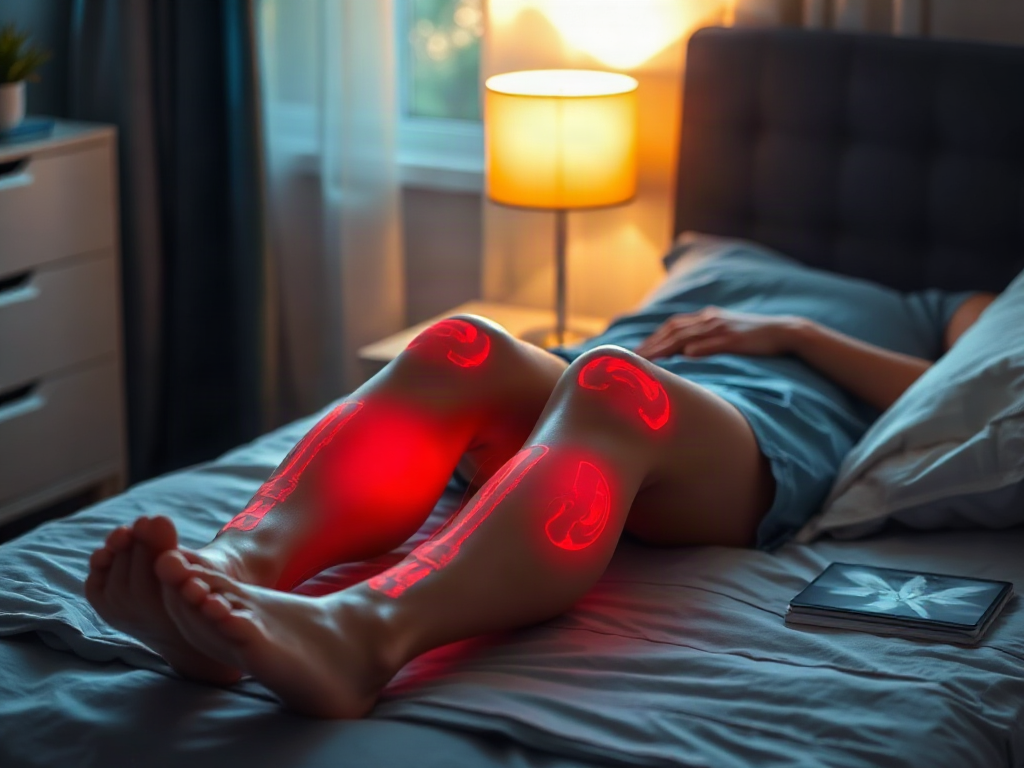
Knees hurting while lying down may result from osteoarthritis, bursitis, tendon irritation, an old injury, inflammatory arthritis, or pressure from a sleeping position. Symptoms that worsen at night can reflect reduced movement, fluid accumulation, joint inflammation, or tissues being compressed when the leg remains bent or straight for hours. Changing leg support, avoiding direct pressure, and noting swelling, warmth, stiffness, or recent activity can help clarify the pattern. Seek prompt medical care for a hot swollen joint, fever, inability to bear weight, major injury, calf swelling, or sudden severe pain. Persistent or regularly sleep-disrupting symptoms deserve a clinician’s assessment rather than repeated self-treatment.
What Nighttime Knee Symptoms Can Reveal
The timing of discomfort provides useful clues, but it does not identify a diagnosis by itself. A knee that aches only after lying still for several hours may be reacting to stiffness, sustained pressure, or a position that keeps the joint partly bent. A knee that throbs during the night and remains painful during the day may reflect a more active inflammatory process, an injury, or degenerative changes that are aggravated by daily loading.
Reduced movement matters because normal activity repeatedly changes pressure inside and around the joint. When the leg stays still, irritated tissues may feel tighter, and a person may become more aware of sensations that were less noticeable while walking or working. Osteoarthritis can produce this pattern, particularly after a demanding day, although nighttime symptoms are not exclusive to arthritis. Tendon irritation, bursitis, meniscus problems, and referred pain from the hip or lower back can also be felt near the knee.
Notice whether the discomfort is on one side or both, at the front or back, and whether it is aching, burning, sharp, or associated with catching. For example, pain at the front of the knee when the leg remains bent may fit a different pattern from pain behind the knee accompanied by calf tightness. Recording these distinctions is more useful than simply rating the pain as mild or severe. The Knees hurting while lying down: possible causes topic becomes easier to interpret when nighttime symptoms are compared with daytime movement, stairs, kneeling, and sitting.
A common mistake is assuming that nighttime discomfort automatically means the joint is being damaged while asleep. Sleep position can aggravate an existing problem without causing new structural injury. Conversely, dismissing repeated night waking as “just stiffness” can delay evaluation of a swollen, infected, inflammatory, or circulation-related condition. Pattern, associated signs, and persistence should guide the next decision.
Common Causes Based On Location And Pattern
Osteoarthritis is a frequent explanation for an older or repeatedly loaded knee that becomes stiff after rest. The joint may hurt when turning in bed, standing after sitting, climbing stairs, or beginning a morning walk. Wear-related changes do not affect everyone in the same way, so imaging or age alone cannot establish that osteoarthritis is responsible. A clinician may consider the examination, symptom history, movement limitations, and other conditions before recommending treatment.
Pain at the front of the knee may involve the patellofemoral joint, especially when the knee has been bent for a long time. A person who spends the day climbing stairs, squatting, cycling, or sitting with the knees flexed may notice aching when lying with a pillow behind the knee. Supporting the leg in a slightly less compressed position may be more useful than forcing it completely straight. Patellar tendon irritation can also follow jumping, running, or a sudden increase in training.
Pain along the inner or outer side may follow a twisting injury, ligament strain, meniscus irritation, or overuse of nearby tendons. A side sleeper may add pressure by resting one knee directly on the other. A pillow between the thighs can reduce contact, but it will not repair a significant injury. Swelling, locking, repeated giving-way, or an inability to fully straighten the leg raises the value of a professional assessment.
Back-of-knee symptoms deserve separate attention. A fluid-filled swelling related to joint irritation can create fullness or tightness, while hamstring or calf strain may cause pain when the leg is stretched. Calf swelling, warmth, redness, or sudden tenderness is not a routine sleep-position issue and should be assessed promptly because circulation problems can sometimes resemble musculoskeletal discomfort.
Inflammatory arthritis may cause prolonged stiffness, warmth, swelling, and symptoms in more than one joint. Gout can produce abrupt, intense pain with marked tenderness and swelling. Infection is less common but more urgent, particularly when a hot swollen joint occurs with fever or feeling unwell. The weak assumption to avoid is that every nighttime ache is mechanical. A new systemic symptom or rapidly changing joint pattern shifts the priority from home comfort measures to medical evaluation.
Sleep Position And At-Home Measures
Position changes are reasonable first measures when the knee has no emergency warning signs and the symptoms appear linked to pressure or prolonged flexion. Side sleepers can place a pillow between the knees so the upper leg does not pull the painful knee inward. Back sleepers may try a small cushion under the lower legs, but the best height is the one that reduces strain without keeping the knee tightly bent for hours.
Comfort is not the same as correction. A pillow that briefly reduces pain may still be unsuitable if it causes numbness, increases pressure behind the knee, or leaves the joint more stiff on waking. Try one adjustment at a time for several nights and note whether falling asleep, turning over, and getting out of bed become easier. If a position repeatedly increases symptoms, abandon it rather than trying to “push through” nighttime pain.
Daytime choices can influence the night. A sudden increase in walking, hills, squats, kneeling, or running may irritate tissues that become noticeable once activity stops. Relative rest means reducing the aggravating load while preserving comfortable movement; it does not necessarily mean complete bed rest. Gentle range-of-motion movements before sleep may suit stiffness, whereas forceful stretching can aggravate an acute strain or swollen joint.
Cold or heat has different practical uses. A wrapped cold pack may feel appropriate after a recent activity-related flare with swelling, while warmth may make stiffness feel easier for some people. Neither approach establishes the cause or guarantees recovery. Skin should be protected, and prolonged direct exposure should be avoided. Over-the-counter medicines also require caution because stomach, kidney, liver, heart, pregnancy, and medication considerations can change what is appropriate; a pharmacist or clinician can help when there is uncertainty.
One frequent failure mode is changing several variables at once—new exercises, medication, a brace, and a different mattress—then being unable to tell what helped or harmed. A simpler trial gives clearer information: reduce the obvious aggravating activity, adjust leg support, maintain comfortable motion, and reassess the trend rather than judging a single night.
When Symptoms Need Medical Attention
Urgent assessment is appropriate for a knee that becomes suddenly very swollen, hot, red, or severely painful, particularly with fever or chills. An inability to bear weight after an injury, a visible deformity, a locked knee, or a loud injury followed by rapid swelling also warrants prompt care. These features can indicate a significant injury or an infection and should not be managed solely with sleep-position experiments.
Calf symptoms change the risk calculation. New swelling in one calf, warmth, redness, unusual tenderness, or shortness of breath requires urgent medical attention rather than massage or vigorous stretching. Knee pain can coexist with a circulation problem, and home treatment cannot safely distinguish every cause. Emergency services are appropriate for breathing difficulty, chest pain, fainting, or rapidly worsening symptoms.

Less urgent but persistent symptoms still deserve a planned appointment. Arrange an evaluation if the discomfort repeatedly interrupts sleep, continues despite reducing aggravating activity, gradually worsens, or is accompanied by morning stiffness, recurring swelling, weakness, or instability. A clinician may assess the hip and back as well as the knee because pain can be referred from nearby areas.
Bring useful observations: when the symptoms began, whether there was a twist or workload change, the exact location, swelling timing, sleep position, and what happens with stairs or walking. A photograph of visible swelling taken during a flare can be helpful if the appearance changes before the appointment. Avoid assuming that an X-ray is always the first or only answer; examination findings determine whether imaging, blood tests, physical therapy, or another evaluation is appropriate.
Waiting has a tradeoff. Mild, clearly improving soreness may justify short-term self-care, but repeated night waking can reduce sleep and make pain feel more intrusive the next day. Seeking assessment does not mean a serious disease is present; it means persistent symptoms have crossed the point where guessing offers diminishing value.
A Practical Plan For Tracking The Problem
A short symptom record can separate a positional flare from a condition that needs broader evaluation. For five to seven days, write down the evening activity, time symptoms begin, sleep position, pain location, swelling or warmth, nighttime awakenings, and morning stiffness. Note whether walking, stairs, kneeling, or sitting changes the discomfort. This record is more actionable than a general statement that the knees hurt at night.
Use the pattern to choose the next step:
- Pressure-related and improving: continue the comfortable pillow arrangement, avoid direct contact, and gradually resume normal activity.
- Activity-related and recurring: reduce the recent workload, review footwear and movement demands, and consider professional guidance if the pattern persists.
- Swollen, warm, unstable, or mechanically blocked: arrange medical assessment instead of escalating home exercises.
- Sudden and severe, or paired with fever or calf changes: seek urgent care.
A useful sign of improvement is not merely lower pain at bedtime. Better sleep continuity, easier turning, less morning stiffness, and improved tolerance of ordinary movement suggest that the current approach may be helping. Failure looks like progressively earlier nighttime pain, increasing swelling, new weakness, or a shrinking range of motion. Those changes should prompt reassessment.
People often overvalue braces, special mattresses, or supplements because they offer a simple explanation and purchase. Such products may improve comfort for selected users, but they should not substitute for identifying an injury, inflammatory condition, or workload problem. The Knees hurting while lying down: possible causes question is best handled by matching the response to the pattern, not by choosing the most advertised remedy.
Keep a follow-up appointment focused on decisions: what findings support the suspected cause, what activity is safe now, which symptoms should trigger faster care, and when progress should be reviewed. That approach limits both unnecessary alarm and prolonged self-treatment.
For evidence-based background, readers can consult public health information from the National Institute of Arthritis and Musculoskeletal and Skin Diseases, MedlinePlus, and the Centers for Disease Control and Prevention. These resources can explain arthritis, musculoskeletal symptoms, and urgent warning signs, but they cannot diagnose an individual knee problem.
Frequently Asked Questions
Why do knees hurt more when lying still?
Prolonged stillness can increase stiffness and awareness of irritated tissues. A bent or compressed position may add pressure, especially after a physically demanding day.
Can a pillow reduce nighttime knee discomfort?
A pillow between the knees or beneath the lower legs may reduce pressure and twisting for some sleepers. Stop using it if it causes numbness, more swelling, or greater morning stiffness.
Does nighttime knee discomfort always mean arthritis?
No. Arthritis is one possibility, but tendon irritation, bursitis, injury, inflammatory conditions, referred pain, and sleep-position pressure can produce similar symptoms.
When should nighttime knee pain be checked?
Arrange an evaluation when symptoms repeatedly disturb sleep, persist, worsen, or occur with swelling, warmth, instability, locking, or prolonged stiffness.
What knee symptoms require urgent care?
Seek prompt care for a hot swollen joint with fever, inability to bear weight after injury, deformity, sudden severe pain, or calf swelling and warmth. Breathing difficulty or chest pain is an emergency.
Conclusion
Nighttime knee discomfort is a pattern to investigate, not a diagnosis to assume. Start by noting location, swelling, recent activity, sleep position, and whether movement improves or worsens the symptoms. A modest position change and temporary reduction in aggravating activity may be sensible when the knee is stable and clearly improving. Repeated sleep disruption, progressive stiffness, instability, or persistent swelling calls for a clinical assessment. Treat hot swelling, fever, major injury, inability to bear weight, or concerning calf symptoms as higher-priority warning signs. The most reliable next step is to compare the night pattern with daytime function and use that information to decide between brief self-care, a scheduled appointment, and urgent evaluation.