
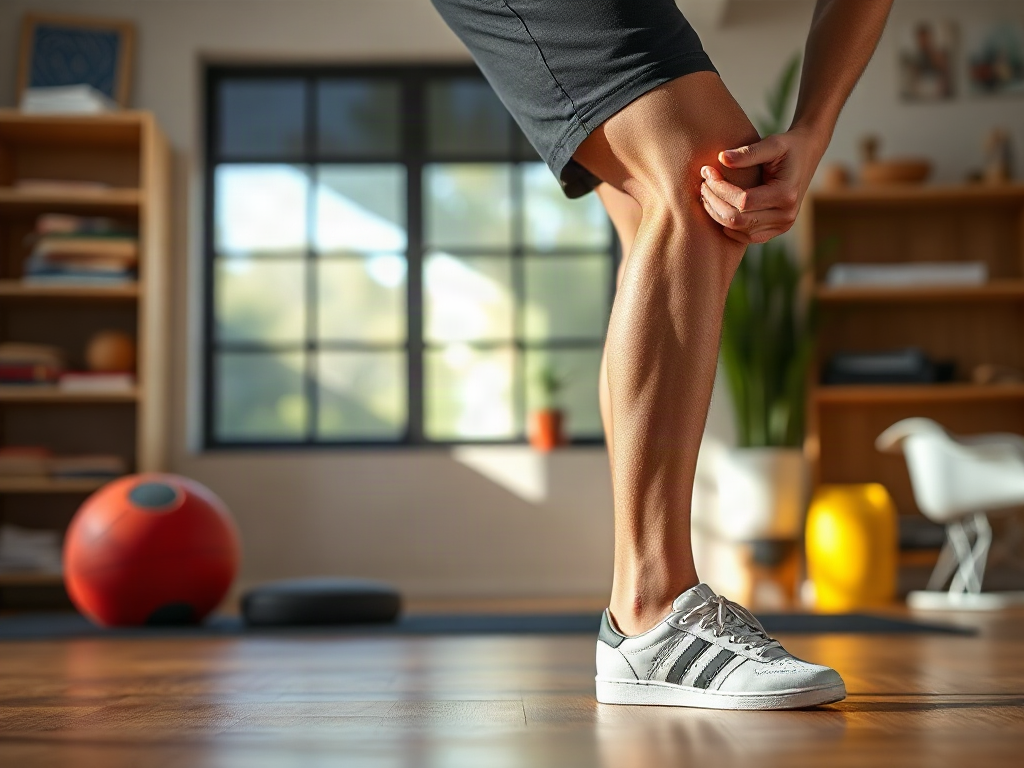
IT band pain relief for activity-related knee pain usually combines a temporary reduction in irritating activity, gradual hip and leg strengthening, and correction of training or movement loads rather than aggressive rubbing directly on the painful spot. The iliotibial band can become sensitive where it passes the outer knee, especially after sudden mileage increases, hills, speed work, or repeated knee flexion. Use relative rest, comfortable mobility, and progressive exercises while monitoring symptoms during and after activity. Persistent pain, swelling, locking, instability, trauma, or pain that does not improve with load changes warrants assessment by a clinician because other knee conditions can feel similar.
Recognizing IT Band-Related Outer Knee Pain
Iliotibial band irritation typically produces aching or sharp discomfort on the outside of the knee during repetitive activity. The band is a thick strip of connective tissue running along the outer thigh from the hip toward the upper shin. It helps transmit forces between the pelvis, thigh, and lower leg, but it is not a muscle that can simply be stretched loose with a few forceful repetitions.
The pattern often matters more than the label. A runner may feel pain after several miles, particularly while descending a hill, and notice that walking on level ground is initially comfortable. A cyclist may develop symptoms after raising weekly volume or using a resistance setting that keeps the knee repeatedly bent. Tennis, hiking, and field sports can create a similar pattern through repeated flexion, turning, or sloped surfaces.
Activity-related timing is useful, but it does not prove the diagnosis. Outer-knee symptoms may also come from a lateral meniscus problem, ligament injury, arthritis, referred pain, or irritation of nearby tendons. Marked swelling, catching, giving way, pain at rest, or a clear injury makes a simple overuse explanation less convincing. A clinician can distinguish these possibilities with a history and examination.
A common mistake is treating every lateral knee symptom as a tight-band problem and then repeatedly rolling the tender area with intense pressure. That may temporarily change how the area feels, but it does not address a sudden training spike, weak hip control, poor recovery, or an unsuitable route. Use the IT band pain relief for activity-related knee pain approach as a load-and-capacity problem, not as a search for one painful knot.
Immediate Load Changes That Calm Irritation
The first practical step is to reduce the activity that reliably provokes symptoms while maintaining comfortable movement. Complete immobility is rarely necessary for an uncomplicated overuse pattern, but continuing the same mileage, hills, or speed through escalating pain can keep the tissue reactive. Replace a painful run with easy walking, gentle pool exercise, or an upper-body session if those options remain comfortable.
Use symptoms to judge the size of the reduction. Pain that stays mild, does not alter your stride, and settles back to its usual level by the next day is generally a different situation from pain that worsens during the session or lingers more intensely for 24 to 48 hours. This is not a diagnostic test, but it provides a sensible guardrail while you arrange professional advice if needed.
Several short-term changes are often more useful than buying a brace or repeatedly applying deep massage:
- Pause hills, downhill running, speed intervals, and sharp cutting drills first.
- Reduce duration or distance before assuming every form change is necessary.
- Check whether a recent increase in frequency, intensity, terrain, or equipment preceded the symptoms.
- Use a cold pack wrapped in cloth for a brief period if it makes the area more comfortable; stop if skin irritation occurs.
For example, someone who increased from two flat runs to four hilly runs in one week may not need to abandon running indefinitely. Returning to shorter, flat sessions after symptoms settle can test tolerance more cleanly than alternating long hill runs with total rest. Conversely, a person whose pain appears during ordinary walking should not use a return-to-running test as the next step.
Footwear, worn-out soles, and a sudden change in running surface can contribute to altered loading, but replacing shoes is not a guaranteed fix. Medication also requires caution: over-the-counter anti-inflammatory drugs may be unsuitable with some medical conditions or other medicines, and masking pain can encourage premature training. Ask a pharmacist or clinician about personal safety rather than using medication to push through a session.
Exercises That Build Better Hip and Leg Control
Strength work is intended to improve the ability of the hip and leg to control repeated loading, not to force the iliotibial band into a longer position. The gluteus medius and other hip muscles help stabilize the pelvis while the leg accepts weight. If the pelvis drops or the knee drifts inward during a step, the outer thigh and knee may experience a less efficient load pattern, especially when fatigue accumulates.
Begin with movements that can be performed without sharp pain or compensation. Side-lying hip abduction, a bridge, and a slow sit-to-stand can establish control. A later progression might include a side step with a resistance band, a split squat, or a single-leg step-down. The exercise is doing its job when the pelvis remains level, the knee tracks generally over the foot, and the effort is felt in working muscles rather than as a rising outer-knee sting.
Quality matters more than a heavy band. During a step-down, use a low step and move slowly enough to notice whether the knee collapses inward or the trunk leans dramatically to one side. If that happens, reduce the height or use support. A stronger-looking exercise performed with poor control is not automatically a better rehabilitation choice.
Mobility work can still have a place, especially for the hip flexors, quadriceps, calves, or buttock muscles when stiffness changes movement. Gentle range-of-motion exercises may make warm-up easier, but forceful IT band stretching is not a proven way to lengthen this dense tissue. Similarly, foam rolling the outer thigh may feel relieving for some people, yet discomfort or bruising is a sign to ease off. Rolling should not replace progressive strength and load management.
A practical sequence is to perform a few controlled strength exercises every other day, then assess how the knee responds later that day and the next morning. Increase repetitions, resistance, or single-leg demand gradually rather than changing all three at once. If symptoms steadily worsen, the program is too demanding or the original diagnosis may be incomplete; a physical therapist can adjust the movement and examine the entire lower limb.
For readers comparing approaches, passive care may feel easier in the first week, while strengthening requires patience and attention to technique. Passive measures can support comfort, but they do not build the capacity needed for a long run, a climb, or repeated lateral movement. The useful combination is the least irritating comfort measure plus a progression that matches current tolerance.
Returning to Running, Cycling, or Court Activity
Return to activity should be treated as a graded exposure rather than a single clearance day. Start with the version of the task that has the fewest known irritants. For running, that may mean a flat route at an easy pace with walk breaks. For cycling, it may mean low resistance and a shorter ride. For court sports, straight-line movement can precede cutting, jumping, and defensive shuffles.
Change one variable at a time. If distance, hills, pace, and training days all rise together, a flare gives little information about what exceeded capacity. A runner who tolerates three short flat sessions can add modest duration before adding hills. A cyclist who feels fine on a low-resistance ride should not immediately select a long climb as the next test.

Warm-up and technique deserve practical, not perfectionist, attention. Five to ten minutes of easy movement can reveal whether the knee is settling or becoming more irritable. Watch for a shortened stride, limping, excessive trunk lean, or a tendency to avoid loading one leg. These signs suggest that the session is no longer a productive progression, even if the pain score sounds modest.
A useful checklist before increasing training includes:
- Daily walking and stairs are comfortable or clearly improving.
- The current exercise dose does not produce a stronger next-day reaction.
- Single-leg movements can be performed with controlled alignment.
- The next increase changes only one demand, such as time or terrain.
Do not use a pain-free warm-up as permission to ignore symptoms that appear repeatedly near the end of activity. Delayed irritation often signals that endurance, recovery, or total weekly load remains ahead of tissue capacity. Rest days, sleep, and spacing demanding sessions can matter as much as the exercise selection. A training log noting route, duration, intensity, and next-day response can expose patterns that memory misses.
The alternative to a careful progression is the boom-and-bust cycle: several days of rest followed by an attempt to resume the old workload immediately. That approach may produce temporary confidence but repeatedly exceeds the current threshold. A slower return can feel inefficient, yet it usually provides better information and reduces the temptation to chase relief with increasingly aggressive treatments.
When Self-Care Is Not Enough
Professional evaluation is appropriate when outer-knee symptoms are severe, recurrent, or not improving after a sensible reduction in aggravating activity. Seek prompt medical care after significant trauma, inability to bear weight, obvious swelling or deformity, fever, a hot or red joint, or a locked knee. New calf swelling, chest symptoms, or unexplained widespread symptoms require urgent medical attention rather than an exercise program.
A sports medicine clinician or physical therapist can examine hip strength, foot and ankle movement, running or cycling mechanics, range of motion, and the precise location of tenderness. That broader assessment matters because a person can have IT band irritation alongside another problem, or may be using the wrong label for pain arising inside the joint. Imaging is not automatically needed for every overuse complaint, but a clinician may consider it when the history or examination raises a different concern.
Evaluation is also worthwhile when the same symptoms return each time activity resumes. Repeated flares may reflect a persistent training mismatch, limited hip or leg capacity, route-specific loading, inadequate recovery, or a condition that needs another treatment strategy. Trying more stretches in isolation can delay the answer.
Bring useful details to the appointment: the exact outer-knee location, the activity and time point when symptoms begin, recent changes in training, swelling or mechanical symptoms, previous injuries, and what improved or worsened the problem. A video of walking or running may help a clinician understand the task, although it does not replace an examination.
Self-care should produce a trend: less discomfort at the same workload, later symptom onset, better control during single-leg tasks, or a calmer response the next day. No change, progressive limitation, or new symptoms should move the priority from experimenting at home to obtaining an individualized assessment.
Frequently Asked Questions
Should I stop all exercise with IT band-related knee symptoms?
Usually, reduce or pause the specific activity that provokes symptoms while keeping comfortable movement such as easy walking or gentle cross-training. Pain that affects walking or continues to escalate needs clinical assessment.
Does foam rolling the IT band fix the problem?
Foam rolling may provide short-lived comfort for some people, but it does not reliably correct training overload or hip and leg control. Avoid forceful pressure over a painful outer knee.
Which exercises are commonly used during recovery?
Controlled hip abduction, bridges, banded side steps, split squats, and step-downs may be useful when performed within tolerance. Progress gradually and stop if sharp pain or poor alignment develops.
Can I keep running while the knee is mildly sore?
Some people tolerate a shorter, slower, flat run if symptoms remain mild, do not alter gait, and are no worse the next day. Repeated pain at a predictable point suggests the workload still needs adjustment.
What symptoms suggest that it may not be the IT band?
Swelling, locking, giving way, pain after a specific injury, pain at rest, fever, or pain inside the joint makes other conditions more possible. A clinician should assess these features.
Conclusion
Effective management of activity-related outer-knee symptoms is less about finding a single stretch and more about matching training demand to current capacity. First identify the activity, terrain, or recent workload change that provokes symptoms, then reduce that demand without abandoning every form of movement. Add controlled hip and leg strengthening, monitor the next-day response, and return to hills, speed, distance, or cutting one variable at a time. Foam rolling and cold can be comfort tools, but neither replaces a progression that improves control and tolerance. Persistent, recurrent, or mechanically concerning symptoms deserve an examination because not every lateral knee complaint comes from the iliotibial band. Use symptom trends and movement quality to guide the next step rather than forcing a return date.