
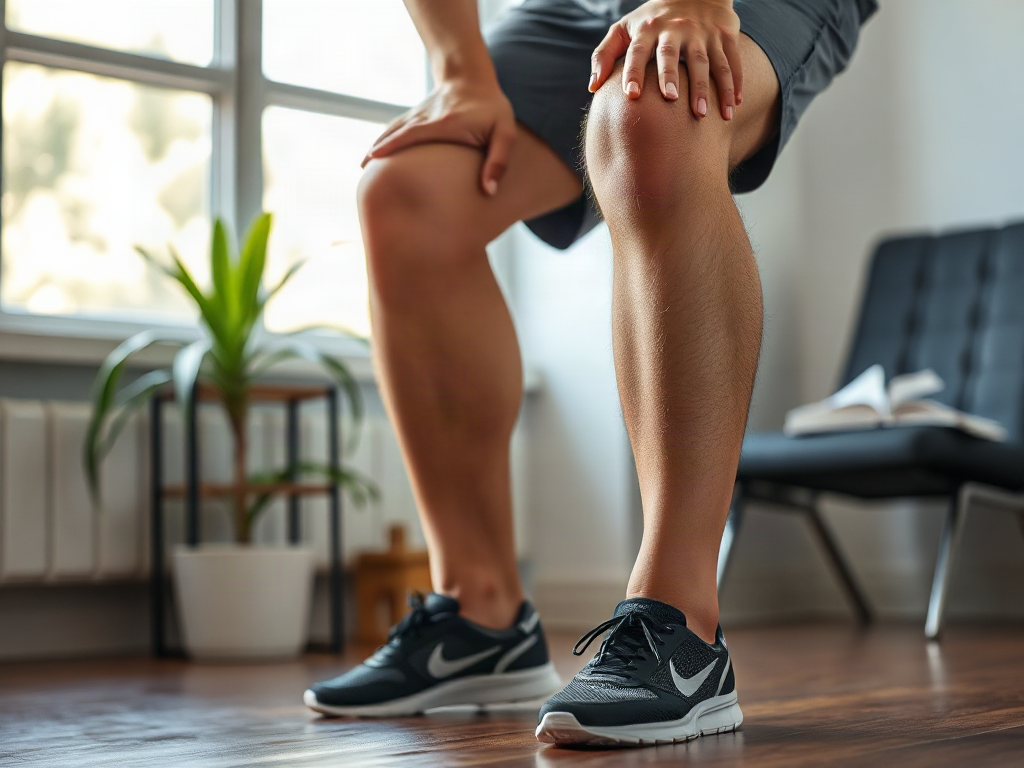
Weak knees: causes and ways to improve stability usually involve reduced muscle strength, poor balance, previous injury, joint changes, or a problem affecting nerves and movement control. Stability often improves when strengthening targets the quadriceps, hamstrings, gluteal muscles, and calves while balance work retrains control around the knee. Begin with low-impact movements such as supported sit-to-stands, step-ups, and controlled heel raises, increasing difficulty only when the knee remains aligned and symptoms do not worsen afterward. Sudden giving-way, major swelling, inability to bear weight, or weakness that develops with numbness requires prompt medical assessment rather than self-directed exercise.
What Weak Knees Can Indicate
“Weak knees” describes a sensation rather than a single diagnosis. Some people notice buckling while walking downstairs; others feel unsteady after sitting, during a turn, or when standing on one leg. The pattern, speed of onset, and accompanying symptoms provide useful clues about what may be limiting stability.
A common contributor is deconditioning. When the quadriceps, hamstrings, gluteal muscles, and calf muscles lose capacity, the knee has less support during weight-bearing. The problem may become obvious after illness, reduced activity, a sedentary period, or an injury that led someone to avoid using the leg normally. Pain can further reduce muscle activation, creating a cycle in which guarding leads to less strength and less confidence.
Previous ligament, meniscus, or kneecap injuries can affect joint control even after the initial injury has settled. Arthritis or other structural changes may produce stiffness, swelling, or discomfort that alters walking mechanics. A hip or ankle problem can also make the knee appear unstable because the leg is not sharing load efficiently. Less commonly, weakness may relate to nerve irritation, neurological disease, medication effects, or a broader medical condition.
Notice the difference between fatigue and true giving-way. Legs that feel tired after repeated activity may need gradual conditioning. A knee that suddenly collapses, catches, or cannot support body weight deserves a different level of caution. Recording when the sensation occurs, whether swelling follows, and which movements trigger it can make a clinical evaluation more useful. An internal link to Weak knees: causes and ways to improve stability can also help readers compare related movement concerns without assuming that every unstable feeling has the same source.
How Strength and Balance Affect Stability
Knee stability depends on more than the knee itself. Muscles around the thigh and hip help control the direction and speed of movement, while balance systems coordinate the foot, ankle, knee, and trunk. When the hip drops inward during a step-down or the foot rolls excessively, the knee may move into a position that feels unreliable, particularly when tired.
Strength training addresses the ability to produce and control force. A supported sit-to-stand, for example, trains the quadriceps and gluteal muscles while resembling a daily task. A low step-up adds single-leg loading, but it also exposes poor alignment sooner than a chair exercise. Balance drills address a different quality: the ability to respond to small shifts in body position. Neither category completely replaces the other.
Start with an exercise that allows slow, repeatable movement. During a sit-to-stand, keep the feet stable, lean forward from the hips, and rise without the knees collapsing inward. During a step-up, use a low platform and hold a rail if needed. The goal is not to reach exhaustion; it is to maintain control through the entire movement. Mild muscle effort is expected, while sharp pain, increasing swelling, or repeated buckling is a reason to stop and reassess.
A frequent mistake is treating instability as a request for harder exercise immediately. Heavy squats or unstable surfaces may be inappropriate when basic control is missing. Another mistake is focusing only on the front of the thigh while ignoring the hip and calf. A balanced program generally begins with supported strengthening and progresses toward standing balance, direction changes, and task-specific practice. A physical therapist can adjust the sequence when pain, surgery, arthritis, or a known injury changes the starting point.
A Practical Progression for Safer Movement
Improving stability works best as a gradual exposure to the movements that currently feel uncertain. Choose a stable surface, wear supportive footwear, and keep a counter or sturdy rail nearby. The first objective is dependable technique, not a demanding workout. If symptoms are worse later that day or the following morning, reduce repetitions, range of motion, or resistance before abandoning the entire approach.
A useful progression may look like this:
- Control: Practice seated knee extensions, supported sit-to-stands, and heel raises with slow lowering.
- Load: Add shallow mini-squats or low step-ups while monitoring knee alignment.
- Single-leg control: Shift weight from side to side, then briefly lift one foot while holding support.
- Function: Rehearse stairs, gentle turns, and walking on predictable surfaces before uneven ground.
Frequency should match recovery. A short session performed consistently may be more useful than an occasional demanding session that causes a flare-up. Someone who has been inactive may begin with a few controlled repetitions and add volume gradually. Someone already exercising may need more specific work, such as slower step-downs or resistance bands, rather than simply doing more repetitions.
Daily choices can protect confidence while capacity develops. Use a handrail on stairs, avoid carrying bulky loads while the knee is unpredictable, and choose a chair height that does not force a painful deep bend. Walking poles or a temporary assistive device may be sensible in some situations, but improper height or technique can create new problems. The best sign of progress is improved control in real tasks—standing from a chair, stepping off a curb, or turning—rather than soreness after exercise.
Do not use a brace as proof that the knee is safe for every activity. A brace may provide comfort or a sense of support for selected conditions, but it does not replace diagnosis, strength, or coordination. The same applies to supplements and topical products: they may address discomfort for some people, but they do not train the muscles that control a buckling knee. For related reading, see Weak knees: causes and ways to improve stability alongside advice tailored to the specific activity that triggers the problem.

When Symptoms Need Medical Assessment
Professional assessment is appropriate when instability is new, recurrent, worsening, or interfering with ordinary activities. A clinician may examine strength, range of motion, swelling, ligament stability, walking mechanics, and the hip and ankle. The useful evaluation depends on the pattern: sudden instability after a twist raises different questions from gradual weakness affecting both legs.
Seek prompt care for inability to bear weight, a visibly deformed joint, substantial swelling after an injury, severe pain, fever with a hot swollen knee, or a locked joint that cannot fully bend or straighten. Weakness accompanied by numbness, spreading tingling, loss of coordination, or bowel or bladder changes requires urgent medical attention. These signs should not be tested with progressively heavier exercise.
Persistent symptoms without dramatic warning signs still deserve attention when they cause falls, restrict stairs, or fail to improve with sensible activity modification. A clinician may recommend physical therapy, imaging, medication review, or evaluation for a condition outside the knee. Imaging is not automatically needed for every mild complaint, and a scan alone does not explain how the leg behaves during movement.
Bring practical details to the appointment: the first date symptoms appeared, whether there was a twist or fall, locations of pain, swelling timing, examples of giving-way, and current exercises. Video of a safe movement may sometimes show the pattern, but do not deliberately provoke a collapse. Medical guidance is especially valuable before returning to running, jumping, pivoting sports, or heavy lifting after an injury.
Frequently Asked Questions
Can weak knees become stronger with exercise?
Often, gradual strengthening can improve force and movement control, but the best exercises depend on the cause, pain level, and injury history.
Why do my knees buckle when I use stairs?
Stairs require controlled lowering and single-leg support. Thigh or hip weakness, pain-related guarding, poor balance, or an injury may contribute.
Should I walk if my knee feels unstable?
Short, level walks may be reasonable when the knee is predictable and symptoms remain mild. Use support and avoid uneven ground if buckling is possible.
Are knee braces useful for instability?
A brace may help selected injuries or provide temporary confidence, but it cannot identify the cause or replace rehabilitation and appropriate assessment.
When should knee weakness be checked by a doctor?
Arrange assessment for repeated giving-way, falls, persistent swelling, inability to bear weight, symptoms after trauma, or weakness with numbness or coordination changes.
Conclusion
Stable knees depend on coordinated strength, balance, joint mobility, and a cause-appropriate plan. Begin by distinguishing ordinary fatigue from true buckling, then use supported movements that let you control alignment and speed. Progress from chair-based strength to step-ups and task-specific balance only when the earlier level is repeatable without worsening pain or swelling. Handrails, sensible footwear, and temporary activity changes can reduce risk while capacity improves, but a brace or supplement should not substitute for evaluation. New or recurrent collapse, major swelling, inability to bear weight, or neurological symptoms warrants medical advice. Tracking the movements that trigger instability gives a clinician or therapist better information and helps turn a vague feeling of weakness into a practical next step.